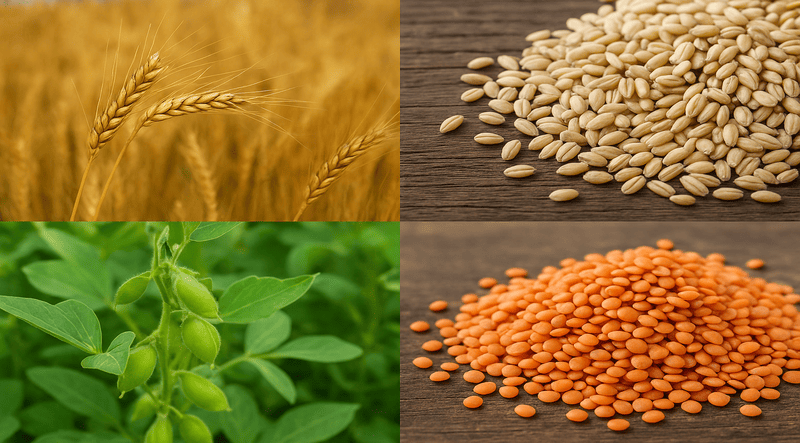
MSP for Kharif Crops 2026–27 | Paddy, Jowar, Bajra, Maize, Moong, Urad, Cotton, Groundnut
Minimum Support Price (MSP) plays a critical role in ensuring that farmers receive a fair and remunerative price for their crops. For the Kharif Marketing Season 2026–27, the Cabinet Committee on Economic Affairs (CCEA), chaired by Prime Minister Shri Narendra Modi, approved an increase in MSP for 14 major Kharif crops. The revised MSPs continue the government's commitment to provide farmers with at least 1.5 times the cost of production while promoting the cultivation of pulses, oilseeds and nutri-cereals.
Why is MSP Important?
MSP is the minimum price guaranteed by the government for purchasing crops directly from farmers, ensuring they do not sell at a loss even if market prices dip. The MSP for 2026–27 continues to be fixed at least 1.5 times the cost of production, in line with the government's commitment announced in the Union Budget 2018–19.
The highest absolute increase in MSP this year is for Sunflower Seed (₹622 per quintal), followed by Cotton (₹557), Nigerseed (₹515), Sesamum (₹500) and Tur (₹450).
Crop wise MSP Table (2026–27 vs 2025–26 with Margin)
| Crop | MSP 2026–27 (₹/quintal) | MSP 2025–26 (₹/quintal) | Increase (₹) | Margin over Cost % |
| Paddy (Common) | 2441 | 2369 | 72 | 50% |
| Paddy (Grade A) | 2461 | 2389 | 72 | 50% |
| Jowar (Hybrid) | 4023 | 3699 | 324 | 50% |
| Jowar (Maldandi) | 4073 | 3749 | 324 | 50% |
| Bajra | 2900 | 2775 | 125 | 56% |
| Ragi | 5205 | 4886 | 319 | 50% |
| Maize | 2410 | 2400 | 10 | 56% |
| Tur (Arhar) | 8450 | 8000 | 450 | 54% |
| Moong | 8780 | 8768 | 12 | 61% |
| Urad | 8200 | 7800 | 400 | 51% |
| Groundnut | 7517 | 7263 | 254 | 50% |
| Sunflower Seed | 8343 | 7721 | 622 | 50% |
| Soybean (Yellow) | 5708 | 5328 | 380 | 50% |
| Sesamum | 10346 | 9846 | 500 | 50% |
| Nigerseed | 10052 | 9537 | 515 | 50% |
| Cotton (Medium) | 8267 | 7710 | 557 | 50% |
| Cotton (Long) | 8667 | 8110 | 557 | 50% |
Government’s Approach to MSP
The government’s pricing formula ensures that farmers receive at least 1.5 times the production cost. For 2026–27, Moong (61%), Bajra (56%), Maize (56%) and Tur (54%) offer the highest estimated returns over cost of production. Additionally, the government continues to promote pulses, oilseeds and nutri-cereals (Shree Anna) by offering attractive MSP support, helping farmers diversify crops while strengthening food and nutritional security.
Benefits for Farmers
- Profit Security: Farmers are assured of a minimum profit margin irrespective of market conditions.
- Encouragement for Diversification: Pulses, oilseeds and cotton farmers gain better price support compared to traditional cereals.
- Higher Procurement: Government procurement will likely increase due to higher MSPs, improving cash flow for rural farmers.
FAQs on MSP of Kharif Crops 2026–27
1. What is the MSP of Paddy (Common) for 2026–27?
The MSP of Paddy (Common) for 2026–27 is ₹2441 per quintal, which is ₹72 higher than the previous season.
2. Which crop has received the highest MSP hike in 2026–27?
Sunflower Seed has received the highest MSP hike with an increase of ₹622 per quintal.
3. Which Kharif crop offers the highest return over production cost?
Moong offers the highest estimated return over production cost at 61%.
4. What is the MSP for Cotton in 2026–27?
The MSP for Cotton (Medium Staple) is ₹8267 per quintal, while Cotton (Long Staple) is ₹8667 per quintal.
5. Why is the government increasing MSP for pulses and oilseeds?
The government aims to encourage crop diversification, reduce import dependency, improve nutritional security and provide better income opportunities for farmers.
Conclusion
The MSP for Kharif crops 2026–27 reinforces the government's commitment to ensuring better income security for farmers. Significant increases for Sunflower Seed, Cotton, Nigerseed, Sesamum and Tur, along with attractive returns for Moong, Bajra and Maize, will help farmers make informed crop planning decisions for the upcoming Kharif season.